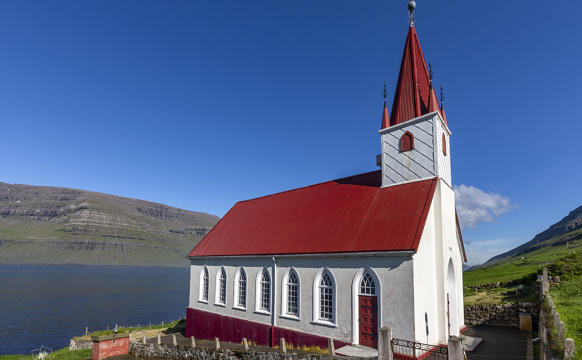
Húsa Church stands as one of the most distinctive stone churches in the Faroe Islands. With its solid masonry and five iron spires, it reflects both architectural ambition and strong community spirit.
On 23 April 1916, the municipal council for Kunoy, Mikladalur, and Húsar parishes sent a letter to the Faroese County and the Provost. They requested a design for a new stone church with an iron roof in Húsar. Earlier that year, strong winter winds had destroyed the old church.
On 19 July 1916, churchwarden Daniel Hansen received permission to dismantle the damaged building. Authorities instructed him to store all usable materials safely. After inspection by two trusted men, he sold materials that could not be reused.
The Faroese Parliament (Løgting) then tasked the County Governor and the Provost with securing drawings and cost estimates for a stone church measuring 12 × 24 alen (approximately 7.5 × 15 metres).
They approached Guttorm Eysturoy, a master carpenter from Tórshavn who had trained in Bergen, Norway. He based the design on Nidaros Cathedral in Trondheim.
Builders prepared the foundation quickly. However, construction paused for about a year while men from Húsar and Syðradalur quarried and shaped the stone. The demanding work required patience, strength, and close cooperation within the community.
Christian J. Sørensen supervised the entire project and carried out the stone and masonry work. Guttorm Eysturoy oversaw the carpentry.
Blacksmiths at Askham’s smithy in Tórshavn crafted the church’s five iron spires. The main spire bears the year 1919, the original target for completion. In reality, the project took longer and cost far more than expected.
Local accounts claim that the expense drained not only the church fund of Norðoyar Parish but also other church funds across the Faroe Islands.
For four years, from 1916 to 1920, the village had no functioning church. On 11 July 1920 (the 6th Sunday after Trinity), Provost Jákup Dahl consecrated the completed building. The ceremony marked the end of a challenging but successful community effort.
Today, Húsa Church serves the villages of Húsar and Syðradalur. Its stone walls and striking iron spires make it one of the most unique and architecturally remarkable churches in the Faroe Islands.
Source: J. P. Gregoriussen, “Nýggjaru Kirkjurnar”; Fólkakirkjan
Húsa kirkja is part of the parish serving Húsar and Syðradalur.
For more information, visit the official Fólkakirkjan page.

 10°C
10°C
