For detailed information, including a map and practical hiking tips, please visit:
https://whatson.fo/hiking/hike/klaksvik-arnafjordur?lang=en
There you’ll find everything you need to prepare for the hike and navigate the route safely.
This hike takes you through the dramatic mountains of the Northern Isles. Along the way, you pass the outfields once owned by the Faroese national hero Nólsoyar Páll and visit the ancient thingstead Katlarnir.
The route begins in Klaksvík and ends in Árnafjørður, though it can also be walked in the opposite direction.
The hike begins at the outfield gate just above Undir Kráarbrekku 21 in Klaksvík, an area also known as Rynkeby. From here, follow the village path north through the pastures of Myrkjanoyrarhagi, passing a lone cottage.
These outfields once belonged to Nólsoyar Páll (1766–1809). He was a shipbuilder, captain, farmer, and poet, and remains one of the most important figures in Faroese history.
Nólsoyar Páll wrote the famous satirical ballad Fuglakvæðið (The Bird Ballad), where birds represented different people in society. While Danish officials disliked the poem, ordinary Faroese found it entertaining. Nólsoyar Páll later disappeared at sea during the winter of 1808–1809.
His farm is currently being reconstructed at Biskupstøð in central Klaksvík and is well worth visiting after the hike.
As you continue, the path passes through old peat fields. In earlier times, residents of Klaksvík cut and dried peat here for fuel. In some places you can still see the remains of ancient turf houses.
The area is also rich in birdlife. Curlew, Oystercatcher, Golden Plover, Snipe, and Herring Gull are often seen here.
As the trail climbs above Ánir toward Áarskarð, the landscape becomes more rugged. The terrain can be slippery when wet, so take care.
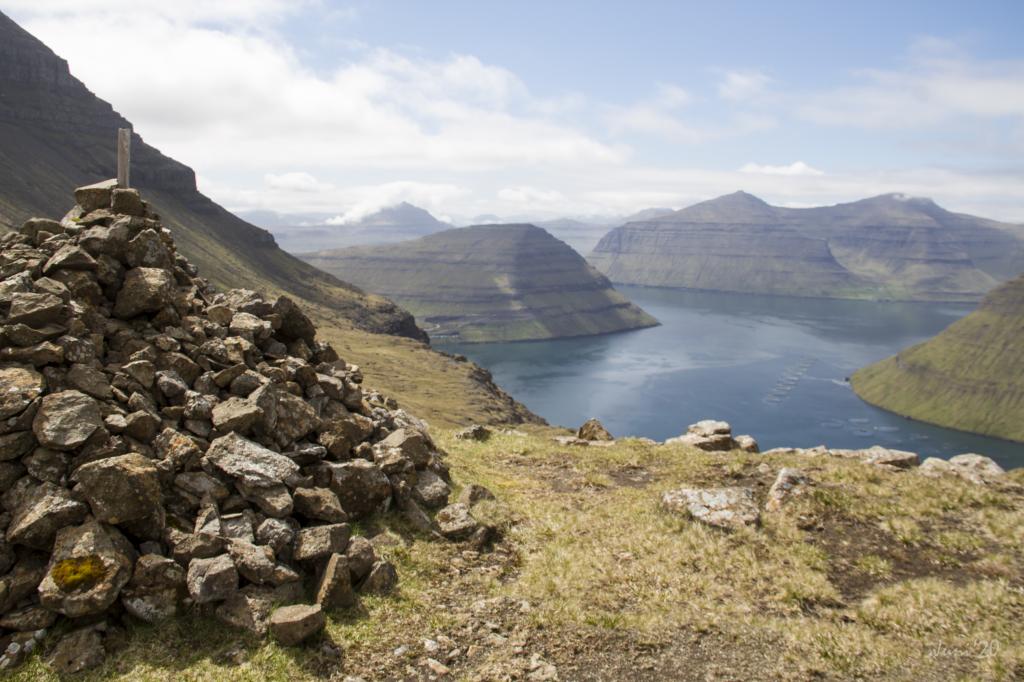
At Áarskarð, the view opens dramatically. Below lies the small village of Árnafjørður, surrounded by steep mountains. To the south rises Lisshøvdi, while Snæfelli towers to the north and Myrkjanoyrarfjall to the south.
In the valley below lies Katlarnir, the historic thingstead of the Northern Isles.
A short detour leads to Katlarnir, where men from the Northern Isles once gathered for legal assemblies. Court sessions were held here in the spring. The exact origin of the site is unknown, but records suggest the thingstead ceased around 1670–1680.
Large and small stones lie scattered across the rocky plateau. The central boulder is known as Tingsteinurin (The Thing Stone).
To reach Katlarnir, walk diagonally down into the valley. Cairns mark the route, though some are difficult to spot. Enter through the area called Niðari Snæhjalli. Near the first large stream, you will reach a fence. Carefully climb over it and cross the creek.
From Katlarnir, you can either return to Klaksvík the same way or continue to Árnafjørður.
If you choose to continue, walk about 500 metres back toward Áarskarð without climbing up again. Instead, maintain roughly the same elevation until you reach Rossastígar. Here you will find a passage between rocks leading down the slope.
Head toward the scout hut further down. From there, follow the path to the road between the two tunnels. Cairns mark the way, but the terrain can be steep in places.
Along the route you will pass Grindasteinur (Pilot Whale Boulder). According to local tradition, villagers once shouted news of pilot whale hunts from this rock down to Árnafjørður.
The descent continues along Ovarustígar, also known as uppi í Jørnunum. Here the path follows an iron fence, and some steps are carved directly into the rock. Cairns and reflective posts guide the way.
Eventually you reach the road between the two tunnels. From here it is about one kilometre to the village.
Between the tunnels and the village there are no posts marking the path. Walk close to Minhúsið, a shelter built during World War II to protect residents from sea mines drifting into the fjord.
From there follow Válagøtan along the ridge toward the village, east of the river Stórá and the church.
Árnafjørður is one of the oldest villages in the Northern Isles. Today many residents work in salmon farming, and the fjord is also known for excellent lobster fishing.
This hike can be walked in either direction. However, the ascent is more demanding if you start in Árnafjørður.

 9°C
9°C
