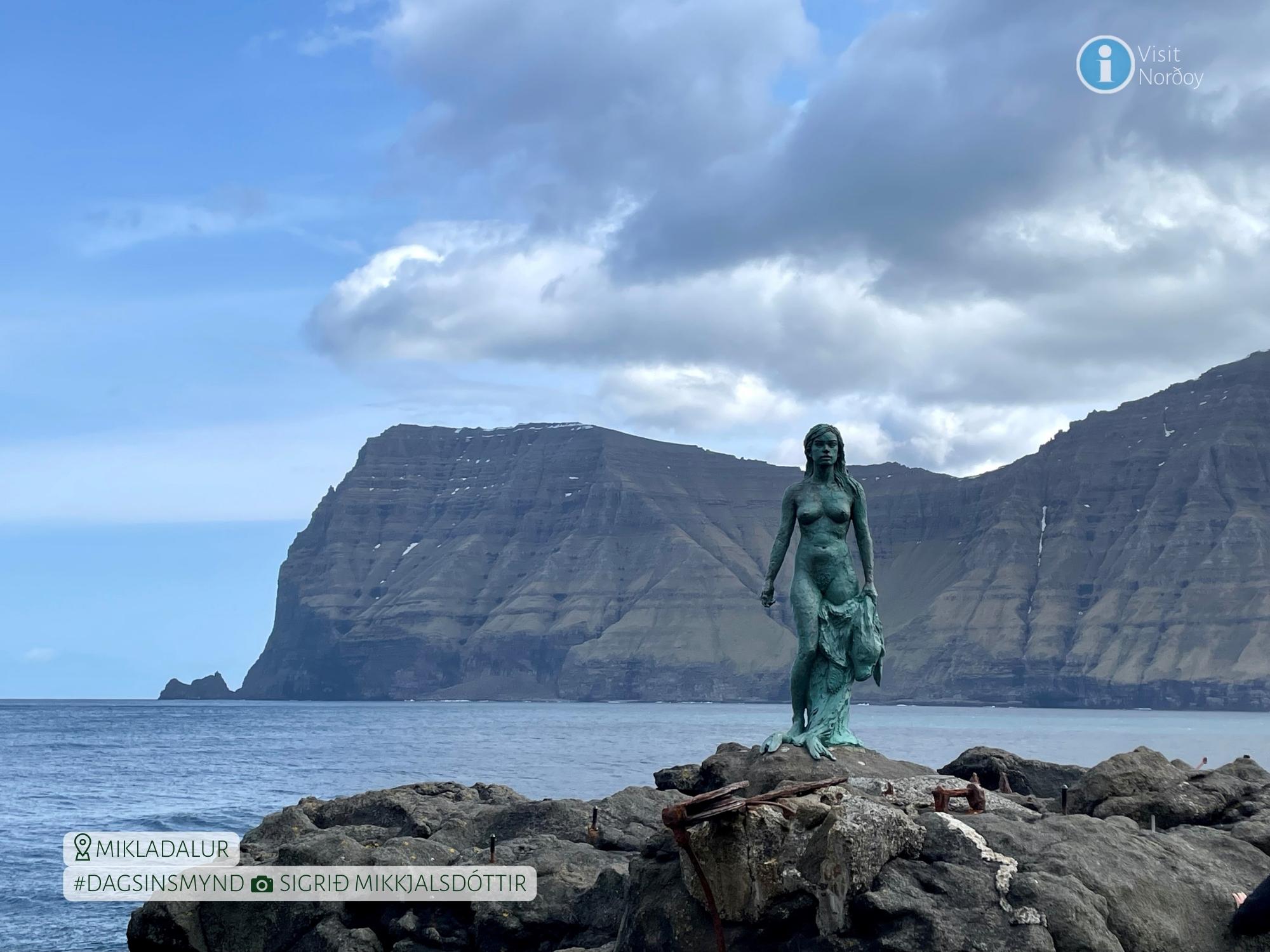
On 1 August 2014, the village of Mikladalur on Kalsoy unveiled a striking statue of Kópakonan – the Seal Woman. Faroese sculptor Hans Pauli Olsen created the artwork. The statue measures 2.6 metres in length, weighs 450 kilograms, and is made of bronze and stainless steel.
Today, the sculpture stands by the sea, where legend and landscape meet. It honours one of the most powerful and well-known folktales in the Faroe Islands.
According to Faroese tradition, seals were once human beings who chose death in the ocean. However, once a year on Twelfth Night (Thirteenth Night), they were allowed to return to land. On that night, they would shed their sealskins, become human, and dance along the shore until sunrise.
One year, a young farmer from Mikladalur decided to discover whether the tale was true. He hid among the rocks on the beach. Soon, he saw seals swim ashore. They removed their skins and transformed into people. Among them was a beautiful seal woman.
While she danced, the farmer stole her sealskin. At dawn, the others returned to the sea. The seal woman searched desperately for her skin but could not find it. The farmer stepped forward and refused to return it. With no choice, she followed him to his farm.
The farmer kept her as his wife for many years. She bore him several children. However, he locked her sealskin in a chest and kept the key on a chain around his belt.
One day, while fishing at sea, he realised he had left the key at home. He told his companions, “Today I shall lose my wife.” The men rowed back quickly, but they arrived too late.
The seal woman had found her skin. Before leaving, she carefully put out the fire and secured the knives so her children would not harm themselves. Then she returned to the sea, where a great bull seal — her true husband — awaited her.
From that day on, people believed that a seal watching the shore was their mother looking at her children.
Years later, the men of Mikladalur prepared for a seal hunt in a distant cave. The night before, the seal woman appeared to the farmer in a dream. She warned him not to kill the great bull seal at the cave entrance, nor the two seal pups inside — her husband and sons.
He ignored the warning.
The hunters killed every seal they found. That evening, as the meat cooked, a loud crash shook the house. The seal woman appeared in a terrifying form. She recognised her husband and sons among the slain animals.
Then she pronounced her curse:
“There shall be revenge on the men of Mikladalur. Some will die at sea and others fall from the mountains, until enough have perished to link hands around the entire island of Kalsoy.”
With a thunderous sound, she vanished.
To this day, the people of Mikladalur remember the curse. When tragedy strikes at sea or in the mountains, some still recall the words of Kópakonan.
The statue in Mikladalur captures this dramatic moment. The Seal Woman sits on the rocks, gazing toward the ocean. Her expression holds both sorrow and strength. Through bronze and steel, Hans Pauli Olsen brings the legend to life.
Today, the sculpture stands not only as a tribute to Faroese folklore but also as a powerful symbol of love, loss, betrayal, and the eternal bond between the Faroese people and the sea.

 10°C
10°C
