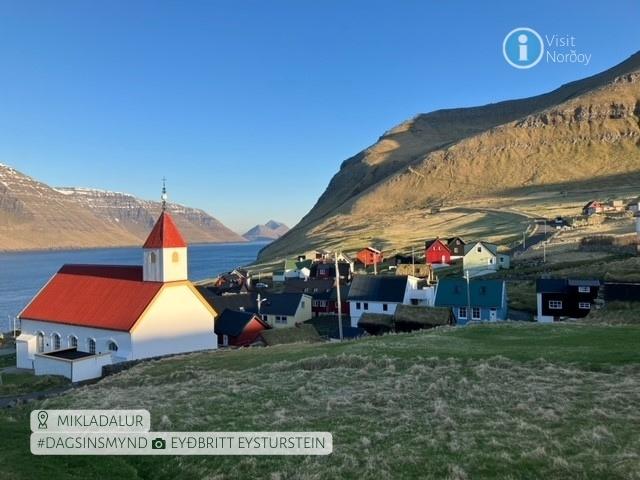
Mikladalur Church has changed significantly since the 19th century. Over time, the community rebuilt and renovated the structure to meet both practical and spiritual needs. Today, the church reflects more than a century of adaptation and dedication.
On 6 July 1855, inspectors declared that the old church in Mikladalur was beyond repair. They also found it too small for the growing congregation. As a result, they recommended demolishing the building and constructing a new church.
An inspection report dated 12 June 1860 confirms that builders completed a new church in 1859. This marked the beginning of a new chapter for the parish.
Between 1900 and 1915, the church once again fell into poor condition. Several inspections documented the damage, and the residents of Mikladalur Parish raised concerns repeatedly.
On 26 May 1909, parishioners wrote to the Faroese County (Færø Amt) to describe the building’s deterioration. Long correspondence followed between the church council, the provost, and county authorities. Much of the discussion focused on funding. Eventually, officials approved a major renovation project.
Builders began renovation work in 1915. They kept the original stone walls but raised them significantly. Workers rebuilt the gables and replaced the old slate roof with iron sheets.
They plastered the exterior and installed wooden cladding inside. The renovation also included new windows — four large and one small on each side — which brought more light into the church.
Carpenters constructed a timber tower, covered it with iron, and crowned it with an iron spire and weather vane. This feature gave the church its distinctive silhouette.
On 15 December 1915, Provost Fr. Petersen consecrated the renovated church. Local residents attended the ceremony, along with former Norðoyar priest Absalon Joensen and the County Governor. The commander of the Danish naval vessel Beskytteren transported the officials to Mikladalur for the occasion.
Today, Mikladalur Church serves the villages of Mikladalur and Trøllanes. The building preserves both its historical structure and its important role in the spiritual life of the community.
Source: J. P. Gregoriussen, “Eldru Hválvkirkjurnar”
Mikladals kirkja serves the villages of Mikladalur and Trøllanes, with regular services every Sunday and public holiday at 12:00 (11:00 during summer).
For more information, visit the official Fólkakirkjan page.

 10°C
10°C
