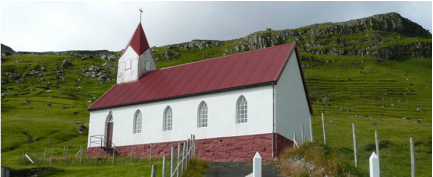
Hattarvík Church stands in the remote village of Hattarvík on the island of Fugloy. It ranks among the Faroe Islands’ most historic churches. The building reflects centuries of faith, resilience, and strong community spirit. Its story remains closely tied to the lives of the islanders.
In early February 1818, seven fishermen from Kirkja set out to sea. Rough waters overturned their boat on the way home. Only two men survived the disaster, and one of them died before reaching shelter in Svínoy.
After this tragedy, the parish decided to move the church from Kirkja to Hattarvík. The community felt that no man in Kirkja could take responsibility for the church at that time. In 1833, the first church in Hattarvík was consecrated.
Over the decades, the church began to deteriorate. By the late 19th century, inspections revealed serious structural problems.
In 1881, inspectors described the tower as rotten and reported that the wood beneath the windows had weakened. Further inspections in 1893 and 1896 confirmed that conditions had worsened. In June 1898, Símun Mikael Zachariassen declared the church practically unusable.
The church council then petitioned the Faroese Parliament for funding to build a new church. The proposed structure would measure 24 × 12 Danish ells (approximately 15 × 7.5 metres).
Petur í Mattalág received the construction contract and signed the agreement on 20 September 1898. Carpenter Magnus av Kamarinum assisted him. Local craftsmen also contributed their skills in stone, wood, and iron. Their combined efforts ensured that the new church reflected the strength of the community.
On 29 October 1899, Heilmann, the priest from Viðareiði, consecrated the new church. Inspectors Líggjas í Keldhúsinum and Guttormur í Geilini approved the completed building on the same day.
The original church had stood at Uppi í Húsi, between cultivated land and the outfields. The new church rose at Niðri í Húsi, on land belonging to the Uttarstova farm. It continues to stand there today.
For more information, visit the official Fólkakirkjan page.

 10°C
10°C
