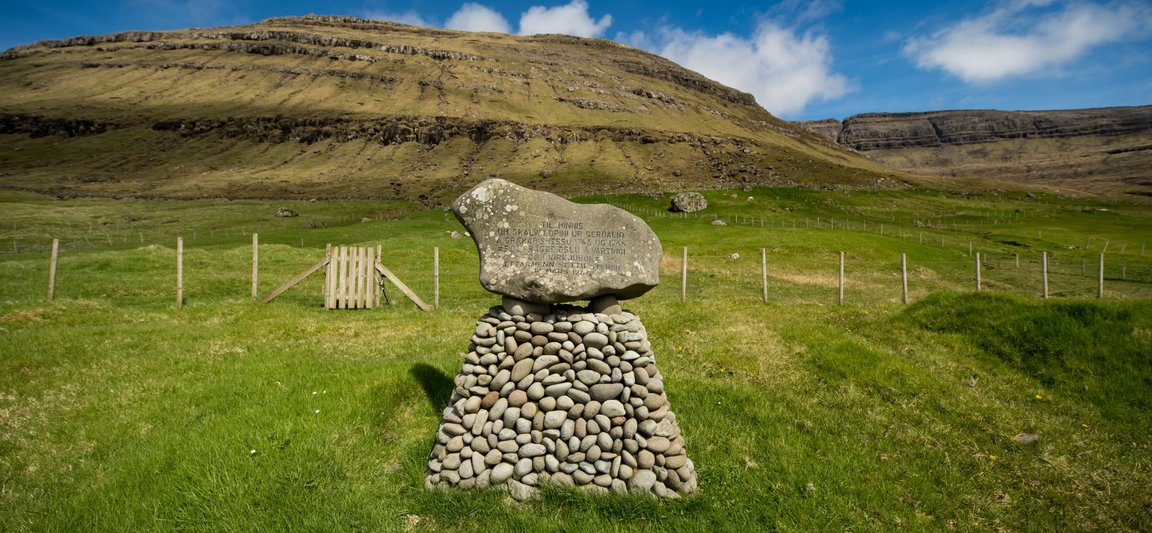
Above Oyravegur in Klaksvík stands the Gerðar Memorial. The town erected the stone monument on 12 March 1945. It honours the victims of two devastating avalanches that struck the settlement Uppi í Gerðum in 1745 and 1765.
Today, the memorial is the only visible sign that a community once lived on this exposed mountainside.
The first disaster occurred on 12 March 1745, on Grækarismessa (St. Gregory’s Day). Snow broke loose from the mountain ridge Kjølin and thundered down toward the farms in Gerðar.
The avalanche severely damaged the farmhouse in Niðristova. Five people lost their lives. Despite the tragedy, the residents rebuilt their homes on the same site. Life continued, even under the shadow of the mountain.
Exactly twenty years later, on 12 March 1765, catastrophe struck again. At twilight, another powerful avalanche swept down the same slope.
This time, the destruction was far worse. Of the 26 people present on the two farms, 20 died. The snow, stones, and debris buried the buildings under a four-metre-thick mass. Norðistova and Niðristova were completely destroyed. Barns, stone houses, and cow sheds collapsed. Of the 23 cattle on the farms, only four survived.
The scale of the loss changed the course of the settlement forever.
After the second avalanche, no one rebuilt on the original site. The area later became known as Uppi í Grundum.
Instead, residents constructed new homes further downhill, closer to Borðoyavík. Those houses still stand today.
According to local belief, no avalanches had struck Gerðar before 1745. None have struck since.
The Gerðar Memorial stands as a quiet reminder of nature’s force and the vulnerability of early Faroese settlements. At the same time, it honours the resilience of the community that survived and rebuilt elsewhere.
Set against the mountains above Klaksvík, the monument preserves the memory of a lost settlement — and of the lives forever linked to that hillside.

 10°C
10°C
